
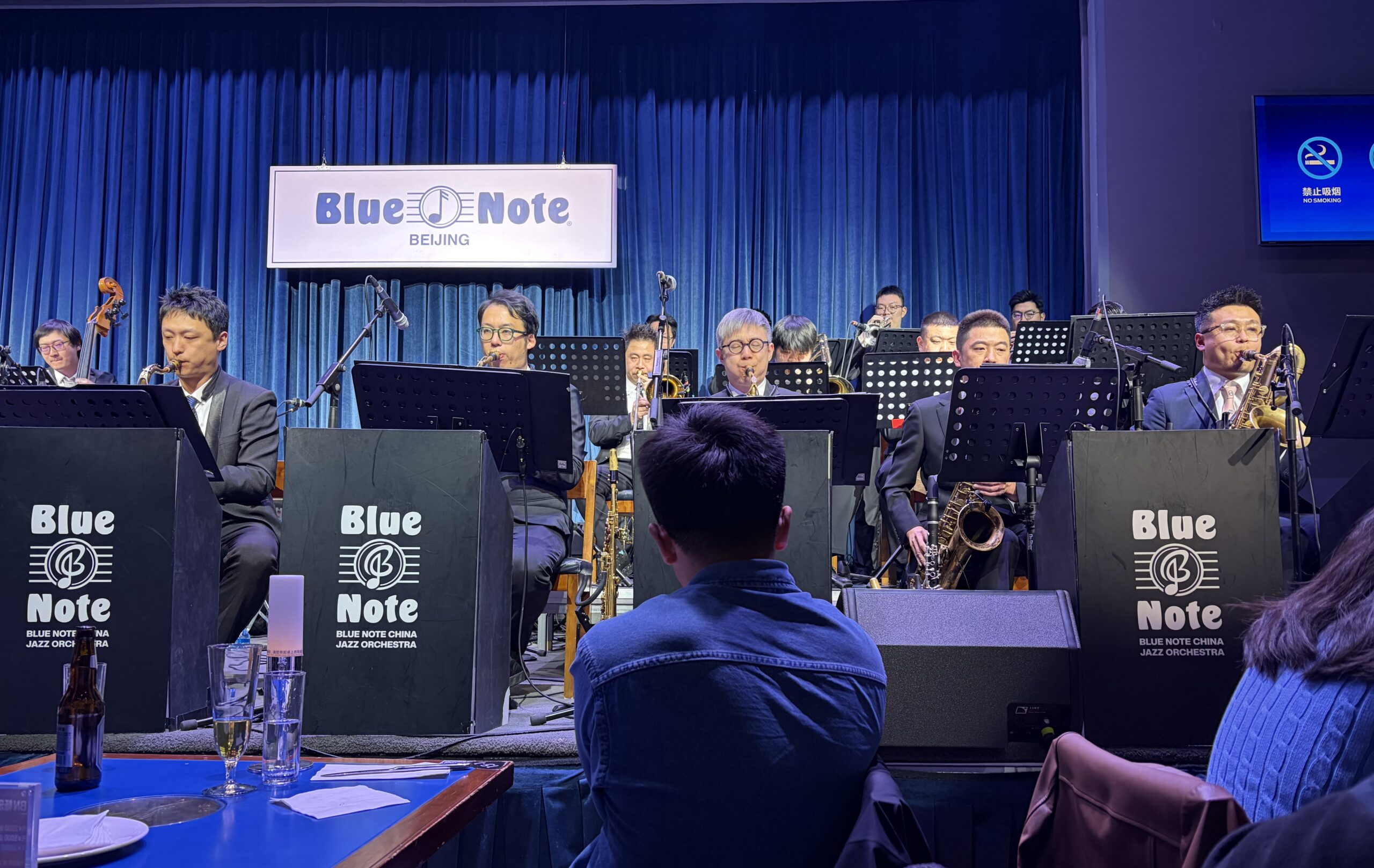
The nonchalant bassline of “So What” sauntered out of the gate, initiating a call-and-response with the horns, and the Blue Note China Jazz Orchestra leaned into the opening notes of a Miles Davis centennial tribute in Beijing.
The sixteen-piece ensemble – four trumpets, three trombones, five saxophones, a pianist, guitarist, bassist, and drummer – was directed by trombonist Yang Ming. A bright trumpet solo emerged from the back of the bandstand as Yang swiveled his trombone around like a cane, the end of the slide resting on the ground. Tenor saxophonist Shi Yujie stood up as soon as the trumpet finished, and immediately shifted the center of gravity to the front row. His spurts of ascending notes grew increasingly aggressive, climbing until they finally broke into altissimo squeals. I could’ve closed my eyes and thought I was hearing John Coltrane.
Rather than featuring one trumpet player in the role of Miles, the concert treated Miles primarily as a composer and bandleader, focusing on music he performed in the 1940s and ‘50s. This choice spoke to the breadth of Miles’s legacy across a 47-year recording career, but it also made the trumpets seem oddly sidelined: buried in the back row, their occasional solos largely outshone by saxophones and trombones. Even the whispery introductory melody of “‘Round Midnight,” handled by Miles on his 1957 recording, was carried here by tenor sax.
The big band arrangement particularly suited pieces from Miles’s collaborations with arranger Gil Evans, like “My Ship” and “Boplicity.” The deep horn section, with saxophones ranging from alto to baritone, floated layers of swirling harmony, dissonant enough to create suspense but not enough to become abrasive or disperse the fog of cool. Several of the sax players grabbed flutes and clarinets for a pastoral intro to a haunting “Dear Old Stockholm,” one of many standards not written but famously recorded by Miles.
Bandleader Yang was long-winded, both because he played the trombone and because of his lengthy commentaries between pieces. He sorted through, backtracked, and revised segments of Miles’s discography out loud, punctuating his Mandarin monologues with grunts of “alright” and “okay” in English. While describing the musical changes these recordings ushered in, Yang named not only the members of Miles’s first great quintet from 1955–59, but also his second great quintet from 1963–68, even though no music from the latter era was in the setlist.
As a soloist, Yang was lyrical and to-the-point, confidently pecking out repeatable themes he stretched and inverted with low, forceful blasts, before turning towards the rhythm section or raising a hand to signal the next transition.

Hidden at the front and center of the stage sat guitarist Qin Jiannan, staring glumly into his music stand. His fingers busily hit chords, slid along the fretboard and bent strings, but I couldn’t hear a single note in the dense mix. Seemingly cut off from the rest of the band, he looked almost like some random guy quietly practicing, oblivious to the concert happening around him.
When the band was introduced, the more confident players indulged with a bow, wave, or toot, but the second and third trombonists looked particularly shy, popping up just momentarily like prairie dogs eager to immediately return to hiding. When he got to the drummer, Bandleader Yang first introduced him as Mark Yang, but then his face lit up with a better idea and he raised his hand high. “Ladies and gentlemen, Philly Joe JONES!!!” he shouted, conjuring the drummer of Miles’s first great quintet. The newly anointed Philly Joe obliged with a cymbal crash.
The set omitted what I consider Miles’s most creatively fertile years, 1969–1975. This fusion period saw him incorporating elements of funk, rock, Indian music, and more into double drummer and double bass lineups, using tablas and electric instruments to create music that still sounds like it came from another planet.
Bandleader Yang addressed this absence directly, listing some of Miles’s ‘70s and ‘80s albums, like Bitches Brew and Tutu, before suggesting with a shrug that the audience might not have dug it. His explanation, or deflection of responsibility, was part of a circuitous introduction of the 1930 Gershwin standard “But Not for Me.” He illustrated the pessimistic meaning of the title with some examples: “It’s a beautiful world, but not for me. Alright. Oh, there’s a pretty woman over there, but not for me. Okay.”
Then he wagged his finger towards the dejected guitarist who was to be featured in the piece. “Qin Jiannan, but not for you!” Qin lowered his gaze to the floor in solemn acknowledgment.
After some bluesy licks and syncopated chords that were finally audible, the corners of Qin’s mouth raised to a bashful smile and he wiggled his ears for the applauding audience.
“Bye Bye Blackbird” was framed by a discussion of Miles’s racial struggles. Nine years after Miles recorded his version of “Bye Bye Blackbird,” the standard was played by segregationists to taunt Selma civil rights marchers in 1965. Bandleader Yang recounted the many times Miles was harassed or even arrested for loitering outside the same venue where he’d just performed. Listening as an American, I thought about how his 100th birthday comes at a time when non-white people in the U.S. are especially worried for their safety amid ICE aggression.
When the tinny rasp of a muted trumpet solo rang out for “Bye Bye Blackbird,” the audience gave extra applause, as if to say “finally, some trumpet!” Bandleader Yang seemed to agree, gesturing to have the soloist’s volume turned up with a big grin on his face.
The duration and vigor of applause seemed to catch the band by surprise.
“We’re done, unless you guys want to hear another one? You do? But that’s all we rehearsed, I don’t know what else we could play.” A pause. “Maybe… Bitches Brew?” I immediately shouted, “Yes!”
Bandleader Yang turned to the drummer. “Can you play that? Okay, let’s jam a little.”
Mark Yang shifted from Philly Joe to Lenny White, striking up a funk beat that followed the spirit more than the letter of the album. The bassist quickly joined in, rocking back and forth as he reached to the bottom of his fingerboard. Bandleader Yang started through the names again while the rhythm players traded solos. He muttered a quick apology when he got to our downcast guitar hero and realized he was interrupting the latter’s solo, pausing for him to finish.
It might’ve taken all night to allow each wind player a solo. So at Bandleader Yang’s cue, they all quoted the first several bars of Miles’s iconic “So What” trumpet solo in staccato unison over the funk beat while the audience clapped along.
This delightful concert mostly celebrated early–mid career Miles Davis as the architect of cool, with the encore pointing towards his later electric years. There is another kind of tribute happening every day, all around the world. As Herbie Hancock once put it when asked what music he would play to honor his former mentor, “Whatever new music young people are making today, that’s what Miles is about.”

在北京庆祝Miles Davis诞辰100周年
《So What》那段条漫不经心的贝斯线,晃晃悠悠地走出来,跟铜管声部一唱一和,Blue Note China Jazz Orchestra在北京就这样拉开了Miles Davis百年诞辰纪念演出的序幕。
这支16人的乐队——四个小号、三个长号、五个萨克斯,加上钢琴、吉他、贝斯和鼓——由长号手杨明担任指挥。一声清亮的小号独奏从乐队后方响起,杨明把手里的长号像拐杖一样转来转去,拉管的那头支在地上。小号刚收声,次中音萨克斯手石喻吉就站了起来,一下子把重心挪到了前排。他一连串往上冲的音越来越猛,越爬越高,最后直接炸成了超高音的尖啸。我闭上眼睛,还以为听着John Coltrane。
这场音乐会没有专门找一个小号手来扮演Miles的角色,而是把Miles当作作曲家和乐队领队来致敬,重点放在他1940年代和50年代演过的音乐上。这个选择确实体现了Miles的47年录音生涯留下的丰富遗产,但也让小号显得被边缘化了——被埋在后排,偶尔冒出来的独奏也基本被萨克斯和长号抢了风头。就连Miles在1957年录音里亲自吹的那首《’Round Midnight》的前奏,在这里也是由次中音萨克斯来演奏的。
大乐队的编配特别适合Miles和Gil Evans合作的那些曲子,比如《My Ship》和《Boplicity》。厚重的铜管声部加上从中音到上低音的各种萨克斯,层层叠叠地飘出那种旋转般的和声,听起来有点不和谐,制造出悬念感,但又不会太刺耳,也不会把那层酷酷的雾气给吹散。好几位萨克斯手还换上了长笛和单簧管,为一首阴魂不散的《Dear Old Stockholm》做了段田园风的前奏——这首标准曲不是Miles写的,但他是最著名的演绎者之一。
乐队领队杨明真是“说来话长”——既因为他吹的是长号,也因为他每首曲子之间都要讲上好一阵。他一边大声说着Miles唱片目录里的各种作品,一边自己整理、推翻、又修改,讲着讲着还时不时蹦出几个”alright”和”okay”。在描述这些录音带来的音乐变革时,杨明不光提到了1955到59年Miles第一支伟大五重奏的成员,还把1963到68年第二支伟大五重奏的成员也点了名——尽管这场演出的曲目单里根本没有那个时期的作品。
作为独奏手,杨明吹得既有旋律感又很干脆,自信地抛出一个个有模有样的主题,再用低沉有力的爆发把它们拉伸、反转,然后转向节奏声部,或者抬手示意下一个段落。
吉他手秦健喃躲在舞台最前面正中间的位置,闷闷不乐地盯着谱架。他的手指忙着按和弦、在指板上滑动、推弦,但在这个密不透风的混响里,我一个音都听不见。他好像跟乐队完全隔离开了,看起来就像一个随便什么人安静地在练琴,压根没意识到旁边正在开音乐会。
介绍乐队成员的时候,那些更自信的乐手会鞠个躬、挥挥手或者吹一声示意,但第二和第三长号手显得特别害羞,像土拨鼠一样嗖地弹出来又急着缩回去。介绍到鼓手时,杨明先说的是杨宸,然后突然灵机一动,脸上亮了起来,高高举起手说:”Ladies and Gentlement,Philly Joe JONES!!!”——召唤出Miles第一支伟大五重奏的鼓手。这位刚被赐名”Philly Joe”的鼓手也很配合地敲了一下镲片。
这场演出跳过了我认为是Miles最有创造力的那几年——1969到75年。那个融合时期,他搞起了双鼓手、双贝斯的阵容,加入了放克、摇滚、印度音乐等各种元素,用塔布拉鼓和电声乐器做出了那种听起来简直不像地球上的音乐。
乐队领队杨明倒是直接提到了这个问题,他列出了Miles70年代和80年代的一些专辑,如Bitches Brew和Tutu, 然后耸了耸肩,意思大概是观众可能不会喜欢。这番解释——或者说甩锅——是他引出Gershwin的1930年那首标准曲《But Not for Me》时的长篇铺垫的一部分。他举了例子来解释歌名里那种悲观的意思:”这个世界很美,但是不是我的。Alright. 那边有个漂亮的姑娘,但是不是我的。 Okay.”
然后他朝那位垂头丧气的吉他手摇了摇手指——这位吉他手即将在这首曲子里担任主角。”秦健喃,but not for you!”秦健喃低头盯着地板,严肃地接受了这个事实。
弹了些布鲁斯小句子和切分和弦——这次终于能听清了——秦健喃的嘴角扬了起来,露出一个害羞的微笑,还对着鼓掌的观众动了动耳朵。
《Bye Bye Blackbird》那首曲子之前,杨明聊起了Miles当年面对的种族困境。Miles录完他的版本九年后,1965年,种族隔离主义者用这首标准曲来嘲讽Selma的民权游行队伍。杨明还讲了好几次Miles在同一个演出场所外面被骚扰甚至因为”闲逛”被捕的经历。作为一个美国人,我在听的时候想到,他的百年诞辰之际,在美国的ICE(移民执法局)攻势下,非白人群体正格外为自己的安全担忧。
当一曲用弱音器闷着的小号独奏在《Bye Bye Blackird》里响起时,观众鼓了格外响亮的掌,好像在说”终于有小号了!”。乐队领队杨明似乎也有同感,他咧着嘴笑,示意调音师把独奏的音量推大。
掌声的时长和热烈程度好像让乐队有点意外。
“我们演完了,除非你们还想听?真想听?但我们就排了这些,我也不知道还能演啥。” 停顿了一下。”要不……《Bitches Brew》?” 我立马喊了一声:”要!”
杨明转向鼓手。”能来吗?行,那就即兴玩一会儿吧。”
杨宸从Philly Joe模式切换到了Lenny White的路子,打出了一个放克节奏——更多是跟着那张专辑的精神走,而不是照搬谱子。贝斯手马上跟了进来,一边够着指板最低的地方,一边前后摇晃。节奏声部轮着独奏的时候,乐队领队杨明又开始挨个念名字。念到咱们那位垂头丧气的吉他英雄时,他发现自己打断了人家的独奏,赶紧嘟囔了一句抱歉,停下来等他弹完。
要是让每个管乐手都来一段独奏,估计得一整晚。所以杨明打了个手势,所有人一起在放克节奏上断奏齐奏Miles那首标志性的《So What》的小号独奏前几小节,观众也跟着鼓掌打拍子。
这场让人听得过瘾的音乐会,主要还是把Miles Davis当作“酷派”的建造者来致敬——聚焦在他职业生涯的中早期。加演部分才指向了他后来的电声年代。其实世界上每天都有另一种致敬在发生。就像有人问Herbie Hancock会选什么音乐来纪念他的前导师时,他说的那句话:“今天年轻人正在做的那些新音乐,那就是Miles的精髓。”
2 responses to “Celebrating 100 Years of Miles Davis”
Alec, your writing of the jazz scene in China completely alters my image of the culture. Breaks down my simplistic view.
Your comment means a lot to me, Rodney! I think the media has treated China in a lot of greyscale that misses out on some vivid colors.