
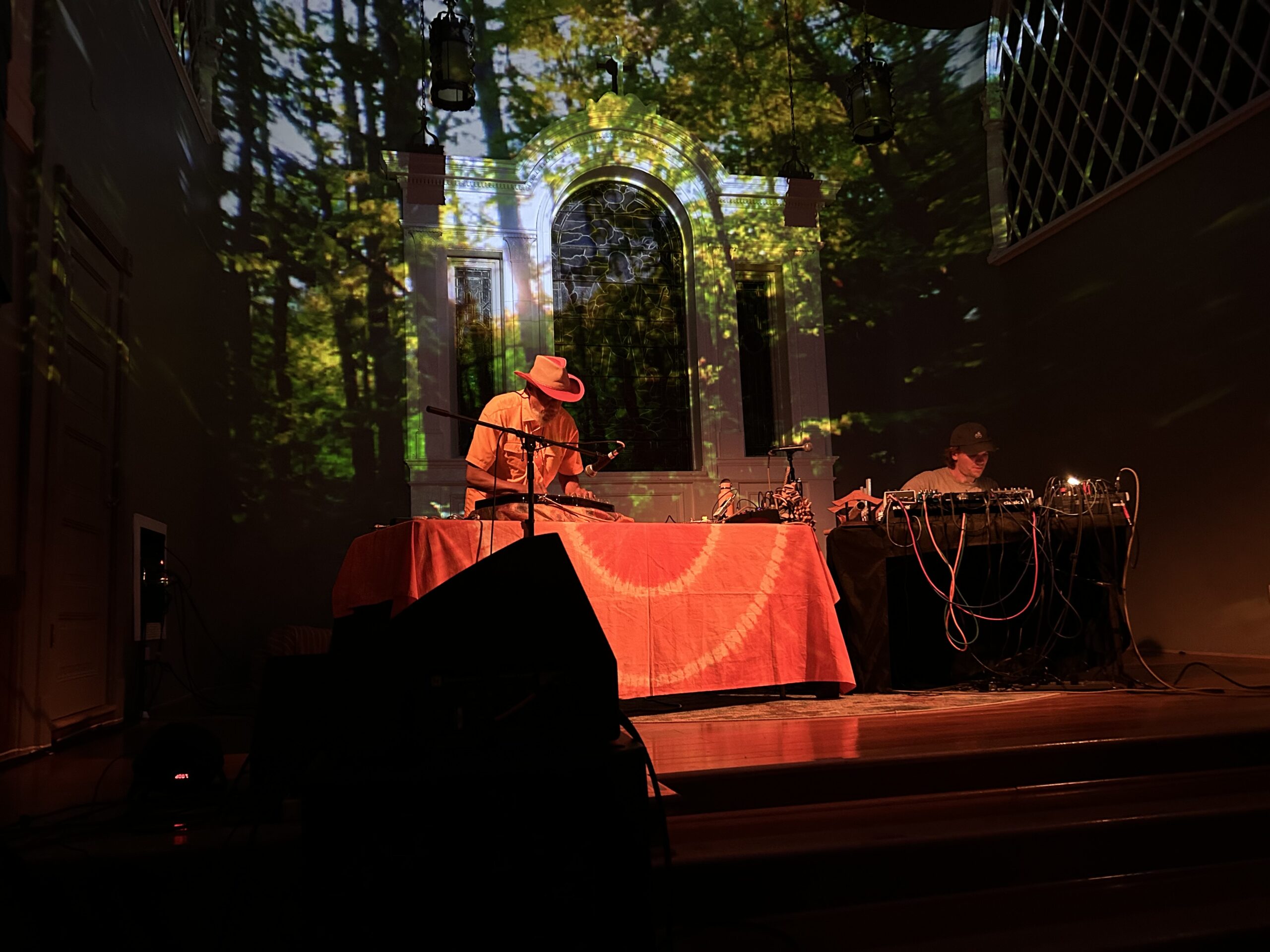
It’s Saturday night, and the pews are full at the Ridgewood Presbyterian Church in Queens, redubbed the Stone Circle Theater. The pulpit consists of two tables covered in electronic knobs, keypads, and percussion instruments. Projected behind the pulpit, a screensaver traces a river’s path through an autumn forest canyon, inadvertently making the life-size Jesus figure etched into the wall appear to walk on water.
A recording of female voices chanting in Latin stops as ecologist-musician Saapato quietly takes the stage. He draws on wilderness recordings taken during his residencies with the Alaska State Park Service and elsewhere to bring the sounds of nature into this urban church. The projected background turns to gray and white streaks; it must be early morning by the creek. Insects chirp and birds whistle over burbling water while a warm, steady synthesizer tone grows in strength like a glowing sunrise. The background image shifts to daytime in the pines.
Saapato lifts a wooden mallet to strike a cylindrical chime. On cue, Laraaji slips beside the table draped in orange–a symbol of enlightenment in Buddhism and Hinduism–next to Saapato’s. Decked in all orange himself from cowboy hat to sneakers, this cosmic prophet has been creating spiritual ambience since the late 1970s, and has collaborated with the likes of Brian Eno and Bill Laswell. A flick of his left hand sets in motion an uptempo disco beat with open hi-hat. The celebratory rhythm carves a driving lane out of what had been a rhythmically agnostic field, creating a sense of boundaries within the infinite. Yet my foot can’t stop tapping.
Laraaji’s right hand races up and down the tiny strings of a zither like he’s trying to calm an anxious pet. The harp-like cascade splashes golden waves over our ears. As his left hand joins in the stroking, his right hand runs a saw-shaped bow over individual strings, yielding brassy croaks like horns ringing out across a valley.
An African thumb piano surfaces as protagonist, marking movement and human activity against an enchanted forest backdrop. The popping texture of each note sits somewhere between melody and percussion, echoing like a disappearing footprint.
The disco beat slowly fades to nothing, returning us to rest in a vast wilderness. Then it starts up again, plunging us deeper into nature’s nightclub as Saapato sneaks off stage.
Laraaji picks up metal brushes and uses them to beat small clusters of zither strings, which bounce and ring out like sprightly acoustic guitar chords. A chopstick appears in his left hand to target individual notes. It’s the closest we get to a zither solo, but each note wants to join the swirl of sound rather than command individual attention. Deeper and higher-pitched thumb pianos establish a dialogue, like parent and child calling out to each other across this ethereal landscape.

As the zither reaches a shimmering climax, we hear rockets blasting off. The soundscape grows dissonant with the first suggestion of minor keys replacing the natural sounds, as if we’ve lifted off the earth into the cold beyond. The visual background shifts to the same gray and white streaks as before, this time suggesting stars and comets streaking by rather than a flowing stream. But as soon as I notice the difference, we’re lowered back into nature with warbles and trickles reentering the mix. Then once more the rockets rev, and we’re launched into a final soothing cacophony of acoustic and electronic noises all melting together.
In silence, Laraaji dances two little circular Tibetan bells in front of his chest for a whole minute before bringing them together three times. Once the resonance becomes inaudible, he looks up at the applauding audience and the Latin chanting resumes.
The show starts and ends with no explanation, allowing attendees their own interpretation. I think about the merging of complementary (not opposite) forces: acoustic and electric instruments, urban and natural settings, Eastern and Western spirituality, even the placement of double ‘a’ in the first versus second syllable of the performers’ names. A blissful calm pervades the murmur of conversation among attendees processing what’s just happened.
You could probably achieve a similar experience listening to wind chimes on a back porch under a starry sky. But in New York City, you’ve got to work hard to make it happen.
4 responses to “Sermon of Sound: An Evening with Laraaji + Saapato”
Beautiful description, you really took me there!
Thank you, brother!
Thanks Alec. I am always learning about musicians who I was not aware of. (And both of these have names with an extra A.)
They sure do.