
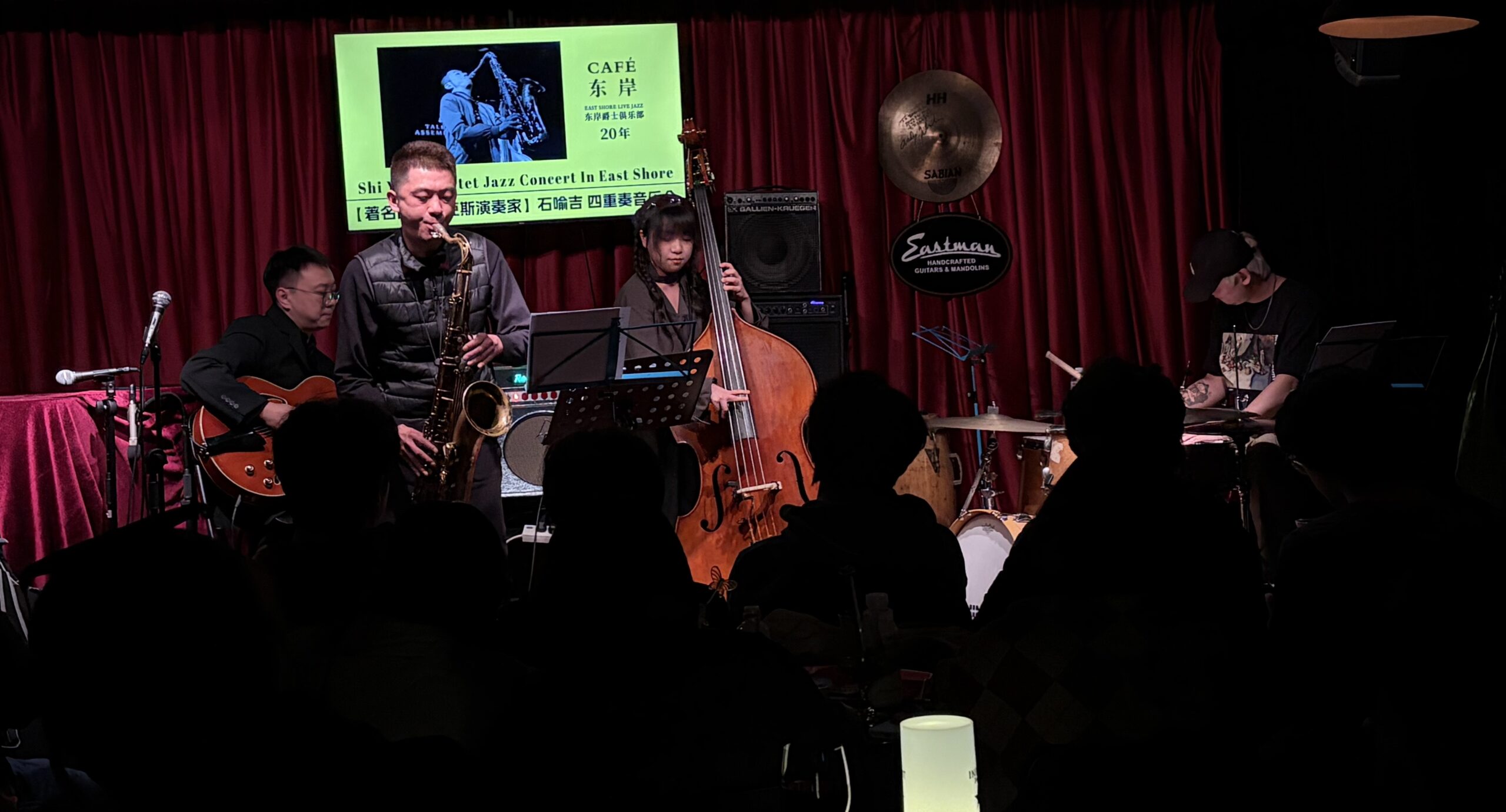
Does music come from within or do we pull it from the air around us? When summoning a piece, Shi Yuji closed his eyes and swayed, snapping his fingers and quietly breathing to an inaudible beat. The music took shape before it was heard, like a ski lift the quartet was waiting to hop on as it swung by.
At Beijing’s East Shore Live Jazz Café, Shi brought unbridled energy he couldn’t wait to unleash through his tenor sax in the form of squeals, sustained ghost notes, and sheets of sound. He leaned forward and stared into the crowd with eyes wide open. At the end of one solo, he sat down as if finished but, with a second wave of inspiration, continued to blow more bars from his chair before standing back up. During a couple of bass solos, he picked up his horn to quietly harmonize, sustaining his presence in the music without overpowering it.
Even the one ballad in the first set was punctuated by bursts of speed and power from the sax. But the resonance of Shi’s tone preserved a sense of beauty even in the most forceful passages.
Live jazz is less about any one instrument than the interaction between the players, and this group’s years of playing together were reflected in their casual synergy. (It may have helped too that most of them were from the same Northeast region of China.) When the sax spiked a quick flurry of notes, the drums immediately responded with a cymbal crash or accented snare hit. With a simple hand cue from Shi, the band could hush down or pick up the pace.
Unfortunately, the quartet’s fluid communication wasn’t the only conversation echoing through the East Shore. The crowd’s chattiness throughout the first half blunted the music’s impact, particularly when the rest of the band quieted down to allow a bass solo. Bassist Bai Yang didn’t appear bothered, but also didn’t add any extra juice to cut through the noise.
Mark Yang’s drum solos hammered through the crowd chatter, feeling more like the shuffling of rhythmic ideas than sheer displays of prowess. After trying out one groove, Yang would let it fall away before gently starting up a new rhythm, eventually raising the volume to a climax that led the rest of the band into the other side of the piece. His kit sat low, at waist height for economy of motion a la Johnathan Blake.
A delayed second half began as soon as guitarist Xia Li – arriving from another gig across town – took his seat. His clear tone added a layer of warmth for a fuller quartet sound.
The highlight of the night was the Bob Haggart standard “What’s New,” a welcomed change of pace from other uptempo numbers. A long, melancholy unaccompanied guitar intro gave way to moody solos from each band member. Here bassist Bai Yang finally got her chance to shine, with enough space for her unhurried low notes to ring out undisturbed, thanks to a more attentive (or perhaps sleepier) audience.
The second set was truncated to just three songs because of the delay. Those who stuck around for the conversation onstage left wanting more, and Shi Yuji’s Quartet sounded like they still had more to say.


石喻吉的四重奏在东岸爵士俱乐部点燃夜空
音乐是从心里流淌出来的,还是从空气中抓取来的?酝酿一首曲子时,石喻吉闭上眼轻轻摇晃,打着响指,跟着听不见的节拍静静呼吸。还没听见声响,音乐就已经成形了——像是四人乐团等着要跳上的空中缆车正晃晃悠悠地荡过来。
在北京东岸爵士俱乐部,石喻吉不可耐地想通过次中音萨克斯释放野性能量——那些尖啸、持续的气声和大片铺陈的音符。他身体前倾,圆睁双眼直视观众。一曲独奏结束,他一屁股坐下像是完事儿了,却又灵光乍现,坐着继续吹出几个小节,才又站起来。几段贝斯独奏时,他拿起萨克斯轻柔地配合,保持着自己的存在感,又不抢风头。
就连第一组曲目里唯一那首抒情歌,萨克斯也不时迸发出快速有力的乐句。但即便在最富冲击力的段落,石喻吉的音色依然保有美感。
爵士现场的魅力从来不在某样乐器,而在于乐手间的互动。这支乐团多年的默契(还有大部分人东北的背景)都体现在不经意间的配合里——萨克斯突然飙出一串急促的音符,鼓手马上用镲片或军鼓回应;石喻吉简单一个手势,整支乐队就能瞬间收声或提速。
可惜,东岸的声场里不只回荡着乐队的流畅对话。上半场观众一直叽叽喳喳,有点冲淡了音乐的感染力,尤其是其他乐器都静下来留给贝斯独奏的时候。贝斯手白阳倒没显得困扰,但也没刻意加大力度穿透那片嘈杂。
鼓手杨宸的独奏压过了人声,与其说是炫技,更像是在碎拍中玩节奏动机。试完一种律动,他会让它自然消散,再轻轻启动新的节奏,最终将音量推向高潮,带着乐队驶向曲子的另一端。他的架子鼓高度只到腰部,效仿Johnathan Blake,追求动作的简洁高效。
下半场因为吉他手夏李从另一场演出赶来而延迟开场。他一落座,清亮的音色就给四重奏添了一层温暖的质感。
当晚的高潮是Bob Haggart那首经典《What’s New》——在满场快节奏标准曲中,这首慢板让人耳目一新。长长的、忧伤的无伴奏吉他前奏过后,每位成员依次献上氛围感十足的独奏。贝斯手白阳终于迎来高光时刻,在变得更专注(或许也更困倦)的观众面前,她不紧不慢的低音得以不受干扰地回荡开来。
因为延迟,下半场只演了三首歌就收场了。那些留下来听完台上对话的人还意犹未尽,而石喻吉四重奏听起来也像是还有很多话没说完。


Leave a Reply