
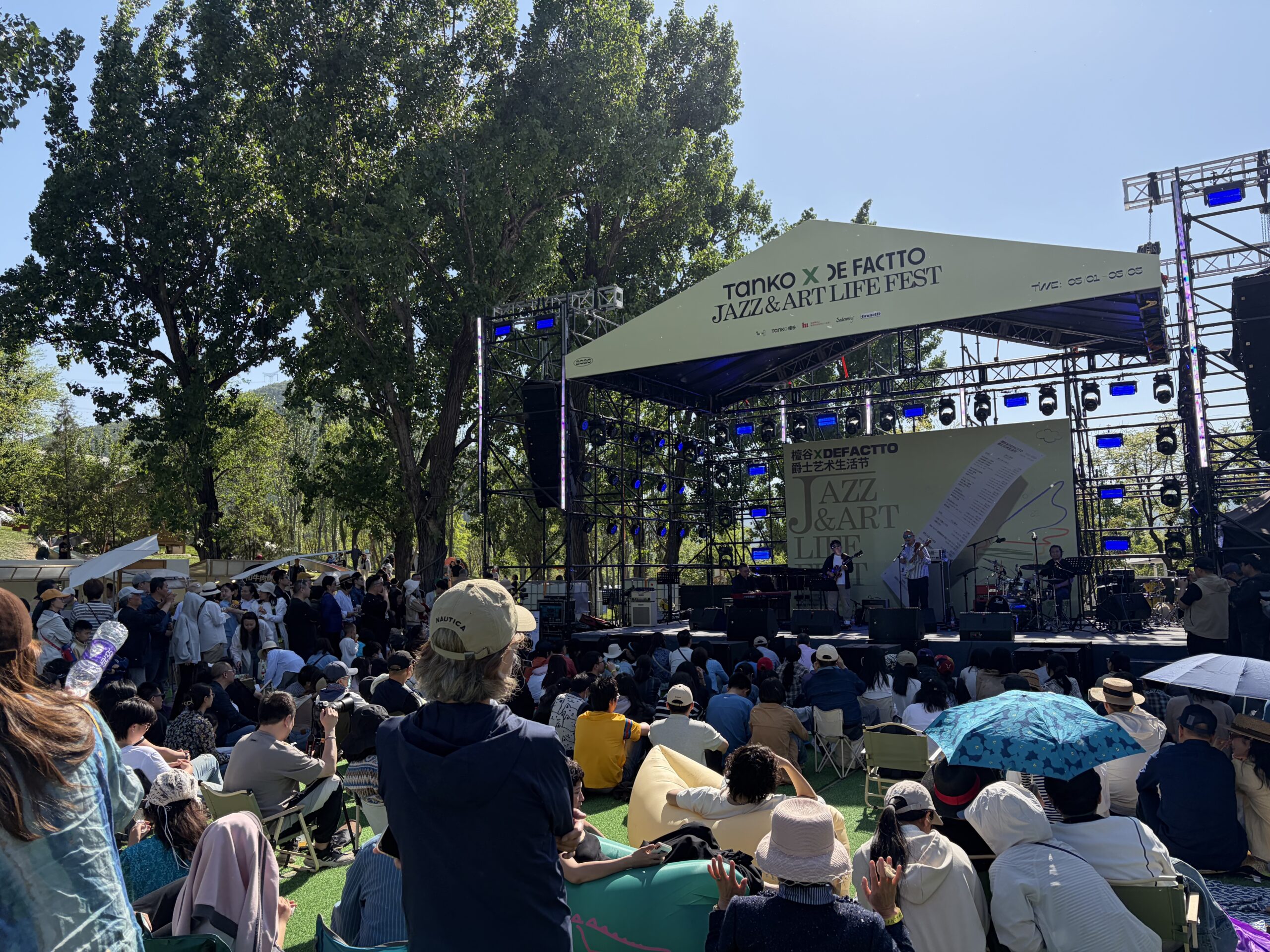
Day 4 of the Defactto Jazz & Art Life Fest featured swing-dancing adults and frolicking children, people kicking off their flip-flops to enjoy microbrews and kebabs on the grass, and musical acts hailing from as near as Beijing and as far as Hungary. Surveying the brightly lit scene under a blue afternoon sky, it was hard to separate the jazz from the art and the life.
Jazz is a set of conventions in music: we recognize jazz in the swing rhythm played on the ride cymbal, a walking bass line, a piano accompanying a saxophone, the horn section of a big band. It’s also an approach to music: we call other music “jazzy” when it leans on loose improvisation. It’s also a cultural phenomenon that we associate with older decades—like the `20s or `50s—and the way people dressed or danced during those times. So is jazz a genre of music, an approach to music, or a culture built around music?
The Defactto Jazz & Art Life Fest showcased jazz as recreation, a suburban escape from workaholic city life that brings people of all stripes together in a party atmosphere, adjacent to other arts and entertainment. And yes, this included jazz music and throwbacks to the costumes and customs of early jazz heydays.
Building a new highbrow shopping center in an unassuming town nestled in the rolling hills of Beijing’s western suburbs, the Defactto organization has invested in a jazz lifestyle lasting far beyond the festival. Spacious book stores, record stores, restaurant-cinema combos, coffee shops, and most importantly an outdoor fountain pool for children invite Beijingers to slow the tempo and unwind. But it’s not just for the city slickers who can afford to relax: local townspeople were given free tickets to the 5-day festival.
The festival’s musical offerings trended towards easy listening jazz, with plenty of blues and pop crossovers, more accessible to the casual listener than the purist “hardcore jazz” circuit of city clubs like the East Shore or Smoke Bar.
With a single stage ringed by snack and beverage booths, the festival provided a focused listening environment in idyllic green surroundings. Listeners laid down blankets in front of the stage, or pitched tents and chairs on the hillside for a scenic countryside view. Standing on the sidelines, I enjoyed my first root beer float in at least a decade from the A&W booth.

Day 4 was headlined by Golden Buddha and His Friends. Golden Buddha’s stocky build and avuncular smile live up to the name, and his 2004 album Summer Palace carved a niche for smooth jazz with Chinese characteristics.
The Buddha began his set with a few minutes of solo piano. Unhurried runs of twinkling lyricism established a peaceful, carefree vibe as he meandered between snippets of Mozart and movie themes. Guitar, bass, and drums eventually joined the piano, settling into a slow, cinematic classic rock groove.
After attempting some gruff vocals that sounded like blues scatting mixed with spoken word poetry, the Buddha pivoted to instrumental jams. “Some days when my voice is feeling good, I can sing. Something must be up with my throat today,” he chuckled between numbers.
Golden Buddha and His Friends took the crowd on a musical silk road, navigating a labyrinth of Middle Eastern scales, and laying down funk grooves that gave way to a lengthy slap and wah-wah bass guitar solo. The set reached its final landing spot in China proper, with an upbeat rendition of Summer Palace’s joyous whistleable title track. The guitarist switched to a three-string Chinese lute, whose nasally banjo-like tone brought echoes of the imperial past into today’s casual surroundings.
Between sets, a group of young couples dressed like our grandparents skipped and swung to early big band jazz tunes, inviting the crowd to gawk and swing along.
The Gyémánt Bálint Trio ratcheted up the intensity after this old-school interlude, demonstrating that jazz isn’t confined to the past. As the sun slowly sunk towards the horizon, the young Hungarian men churned out frenetic fusion and driving funk-rock rhythms. The guitarist’s snarl and lunging stance matched the intensity of his face-melting solos.
While I folded my arms and tried to untangle the pretzel logic of the twisting drum patterns, four-year-olds gleefully jumped and twirled all across the lawn, paying no mind to the difference between `30s swing and modern fusion.
Watching children boogie to music that adults consider too heady for dancing crystallized the meaning of a Jazz & Art Life festival. The music comes in different forms, but it becomes jazz when it connects with a free, adventurous, or relaxed part of ourselves. And that feeling knows no age or geographic limits.


逃离城市,在郊区听一天爵士——Defactto 艺术生活节现场
这是 Defactto 爵士艺术生活节的第四天。现场有跳摇摆舞的大人,有到处乱跑的小孩,有人踢掉人字拖坐在草地上喝精酿、吃烤串,乐队有从北京来的,也有远道从匈牙利来的。放眼望去,午后蓝天下一片亮堂堂的热闹景象,我都很难分清楚哪部分是爵士,哪部分是艺术,哪部分又是生活本身。
爵士乐在音乐上有一套固定的说法:我们能从镲片上摇摇晃晃的节奏里认出它,从行走的贝斯线里听出它,从钢琴给萨克斯的伴奏里感受它,从大乐队的铜管声里辨别它。但爵士也是一种态度——我们管其他音乐叫“有爵士味儿”,通常是因为它带着随性的即兴感。同时它也是一种文化现象,总让人想起上个世纪二三十年代或五十年代,连带想起那时候人们的穿着和舞步。那么,爵士到底是一种音乐类型,一种演奏方式,还是围绕音乐建立起来的一整套文化呢?
在 Defactto 爵士艺术生活节上,爵士被呈现成了一种休闲方式——它是都市工作狂们逃往郊区的出口,把各种不同的人聚到一起,在派对一般的氛围里,跟其他艺术和娱乐形式混在一起。当然,这里面确实有爵士乐,也有对早期爵士黄金年代服饰和习俗的复古致敬。
Defactto 团队在打造一种爵士生活方式,而且不局限于音乐节这五天。他们在北京西郊连绵起伏的山丘之间,一个不起眼的小镇上,建起了一个高档购物中心。里面有宽敞的书店、唱片店、餐厅和影院结合的空间、咖啡馆,最重要的是还有一个户外喷泉水池,小孩可以在里面漂着玩水——所有这些都在邀请北京人把节奏放慢,松一口气。而且这不止是对那些有钱有闲的城里人开放的:当地村民全都拿到了这场五天音乐节的免费票。
音乐节在音乐选择上偏轻松易懂的爵士,混了不少blues和流行风格,对普通听众来说比城里那些纯爵士俱乐部(比如东岸或 Smoke Bar)要友好得多,没那么硬核。
场地只有一个舞台,周围一圈小吃和饮料摊位。整个环境绿意盎然,像个田园风光里的集中听歌区。听众在舞台前铺开野餐垫,或者在旁边的山坡上搭起帐篷、摆上椅子,享受乡间风景。我站在边上,从 A&W 的摊位上买了一杯根汁汽水浮冰,大概十年没喝过这玩意儿了。
第四天的压轴是金佛和他的朋友们。金佛身材敦实,笑容慈祥,名副其实。他 2004 年的专辑《夏日皇宫》在带有中国特色的丝滑爵士里开辟了自己的一小块天地。
金佛的开场是一段几分钟的钢琴独奏。不紧不慢的音符轻轻流淌,带着抒情的味道,在莫扎特的片段和电影主题曲之间随意游走,营造出一种平和又无忧无虑的氛围。后来吉他、贝斯和鼓陆续加入,音乐慢慢进入一种慢速的、很有画面感的经典摇滚节奏。
他试了几段粗粝的人声,听起来有点像blues的拟声即兴混合了念白式的诗歌,后来还是转回了器乐演奏。“有些时候嗓子状态好,我能唱两嗓子。今天喉咙不知道怎么回事,”他在两首歌之间笑着解释。
金佛和他的朋友们带着观众走了一趟音乐丝绸之路,在各种中东调式里穿行,又铺开funk节奏,接着是一大段长长的贝斯独奏,又是 slap 又是哇音。最后音乐回到了中国本土,用一首活泼的、让人忍不住跟着哼的《夏日皇宫》同名曲收尾。吉他手换了一把三弦的月琴,那带点鼻音、有点像班卓琴的音色,让人恍惚间觉得皇朝的旧时光被带进了今天这片随意的草地上。
换场的间隙,几对穿得像我们爷爷奶奶一样的年轻情侣,跟着早期大乐队爵士的曲子跳起了摇摆舞,引来了围观的人群跟着一起晃动。
接下来,Gyemant Balint 三重奏把这个复古插曲之后的氛围提了上去,证明了爵士并不只是属于过去。三个年轻的匈牙利人在夕阳渐渐西沉的时候,玩出了疯狂的电声融合和强劲的funk摇滚节奏。吉他手一脸凶悍,身体前倾,架势跟他的高能独奏一样火力全开。
我抱着胳膊,试图理清那些绕来绕去的鼓点节奏,而草坪上四岁的小朋友们早就开心地跳起来、转起圈来,根本不管这是三十年代的摇摆乐还是现代的融合乐。
看着小孩们跟着大人们觉得“太复杂没法跳舞”的音乐摇头晃脑,我突然明白了“爵士艺术生活节”的真正意义。音乐有不同的形式,但只有当它触碰到我们内心那个自由的、好奇的、放松的自己时,它才真正成了爵士。而那种感觉,不分年龄,也不分地域。
Leave a Reply